Secure Messaging Portal
- Get Started
- Troubleshooting and FAQ
- Release Notes
- AI Agents
- Patient Channel
- Triggers
- Technical Specifications
- Patient Facesheet
- Insights & Analytics
- Conversation Flows
- Campaigns
- SMS Basics
- Inbox
- Lines & Resources Requests
- Lines, Events, Resources
- Referrals
- Add-Ons
- Users and Groups
- Platform Settings and Configuration
- Self-Rescheduling
- Recalls
-
Artera Harmony Federal Edition
Conversation Flows | AHFE Triggers | AHFE Platform Settings & Configuration | AHFE Users and Groups | AHFE Patient Channel | AHFE Troubleshooting and FAQ | AHFE Patient Facesheet | AHFE Campaigns | AHFE Lines, Events, Resources | AHFE Get Started | AHFE Inbox | AHFE Release Notes | AHFE Analytics | AHFE
- Marketplace
Table of Contents
Secure Message Access - Patient-ViewChoosing a LanguageMessage Order and Unread IndicatorAccessing a Secure Message 60-Minutes After DeliveryRequesting a New LinkLogging into Artera without Secure Message Link - Patient View Switching PatientsThis article discusses the patient's view when receiving a Secure Message from Artera. To learn about Secure Messages, click here.
Secure Message Access - Patient View
-
When the patient receives a message containing a secure link, they must click on the link contained in the message to complete the verification process and view the information. This link begins with "http://well.app" and concludes with a string of numbers and/or letters.
NOTE: The screenshot below contains a link sent to a test patient through an Artera demo environment, so the URL varies.
-
Depending on your Default Settings, the patient will verify their identity with one of the options listed here. The verification screen names the patient the message was sent to. For example: "This message is for Noor T. Enter their information to continue." The name shown is the patient's preferred first name, or legal first name, plus the initial of their last name. If more than one patient at your organization shares the phone number the message was texted to, the patient also sees "Not Noor? Choose another patient" and can switch to the right record. If Patient Sign-in Security Criteria set to None, patients skip this step and are routed straight to the message. In that case, there is no named check.

-
Once they have verified their information, the patient will be taken to their Messages page. Each row on this page is a Practice line and the patient can select a row to view the messages from that line. Rows are sorted by date, with the most recent message first. A red dot next to a Practice line name means that line has sent a message the patient has not opened yet. In the below example, the patient has messages from two Practice lines. The row with the red dot has a message the patient has not opened.

Choosing a Language
Patients can use the Secure Messaging Portal in their own language, from sign-in through reading and replying to messages. A globe-icon language selector appears on the sign-in screen and inside the portal.
NOTE: The selector changes the portal's own screens — buttons, labels, sign-in steps and error messages. It does not translate messages. Messages already sent stay in the language they were sent in and a patient's reply is sent exactly as they wrote it.

Thirteen languages are available: English, Spanish, Portuguese, Vietnamese, Chinese (Mandarin, Simplified), Russian, Haitian Creole, Korean, Chinese (Cantonese, Traditional), Arabic, French, Persian, and Somali. Arabic and Persian display right to left.
When a patient opens the portal from a secure message link, by text or email, the portal opens in the patient's preferred language on file. If that language is not one of the thirteen, the portal uses the browser's language, or English. When a patient opens the portal directly and signs in by phone number, the portal opens in a language they previously chose on that device, then the browser's language, then English.
A language the patient chooses in the selector is remembered in that browser on that device and takes priority next time, even over a link.
NOTE: Choosing a language in the portal does not change the patient's preferred language in Artera and users cannot see which language a patient chose.
Message Order and Unread Indicator
The Messages page tells the patient two things: which Practice lines have sent them something new and which message arrived most recently.
Unread indicator
A red dot appears next to a Practice line name when that line has sent a secure message or an RCS webview card that the patient has not opened yet. The dot disappears when the patient opens that line's conversation in the portal. A reply from the patient also clears the dot.
A regular text message counts toward the dot only when it arrives as an RCS webview card. A Conversation Flow message counts when it arrives as a secure message or an RCS webview card. An Artera user closing a Patient Channel does not light the dot.
NOTE: Before a patient has opened a line for the first time, any new message from your organization on that line lights the dot.

Message Order
Rows are sorted by date, with the most recent message first. Whether a message has been opened does not change where its row sits. Automated messages and Campaign messages count toward the date.
NOTE: The unread indicator and this sort order apply to the patient's Secure Messaging Portal only.
Accessing a Secure Message 60-Minutes after Delivery
Patients who access a Secure Message link more than 60 minutes after delivery must enter a 5-digit confirmation code sent to their mobile device, in addition to their standard verification information.
This same confirmation code requirement applies when a patient tries to open an older Secure Message after a new one has been sent to them.
-
The patient receives a message containing a Secure Link, but waits 60+ minutes to access the message.

- The patient clicks on the link and is routed to the Patient Sign In page. Here, they are asked to enter in their 10-digit phone number to receive a confirmation code.

- The patient is sent a confirmation code to their mobile device. This code is valid for 30-minutes.
-
The patient enters the confirmation code into the Confirmation Code window.

-
If the patient's phone number is on file at two or more organizations using Artera, they are asked to Select Health System. A patient with an accout at only one organizaiton skips this step.

-
The patient is asked to verify their identity with the options listed here, based on your Default Settings.

- The patient is then routed to the message sent to them.
NOTE: The label displayed at the top of the message page is the name of the Enterprise and the name of the line used to deliver the message. To edit how the line name displays to patients, edit the line.

Requesting a New Link
When a secure message link has expired, the patient can request a new one by selecting "Send me a new link" after they click the original link. 
After they request it, the button is replaced with "Link sent" and a new link is texted to them. The patient can always choose Sign in another way to sign in with their phone number instead. This page appears only for texted links; an expired email link takes the patient to phone-number sign-in.
NOTE: A patient can request one new link per minute and up to 20 in a 24-hour period, counted from their first request. Requesting again within a minute displays "Link sent" without sending a new link. After 20 requests, the patient sees "Sorry, we could not log you in at this time. Please try again later."
Logging into Artera without Secure Message Link - Patient View
Patients who access the Secure Messaging Portal by visiting app.wellapp.com/login will experience a slightly varied workflow compared to patients who access the Secure Messaging Portal via the Secure Link sent to their mobile device.
- The patient logs out of the Secure Messaging Portal and chooses to log back in or the patient navigates to app.wellapp.com/login.
-
The patient enters their phone number on the Patient Sign In page and selects Continue. Below, the page displays: "By continuing, you agree to receive a one-time text message from Artera with your confirmation code. If your number can't receive texts, we'll call you with the code instead. Message and data rates may apply." Links to Artera's Terms of Service and Privacy Policy appear below the disclosure and open in a new tab.
NOTE: This disclosure appears on the phone-number sign-in page only. It does not appear on the Verify Patient Identity step or on the new-link request page.
- The patient receives a confirmation code to their mobile device. This code is valid for 30-minutes. If the number cannot receive text messages, for example a landline, Artera calls the patient and reads the code aloud instead.
-
The patient enters the confirmation code into the Confirmation Code window.

-
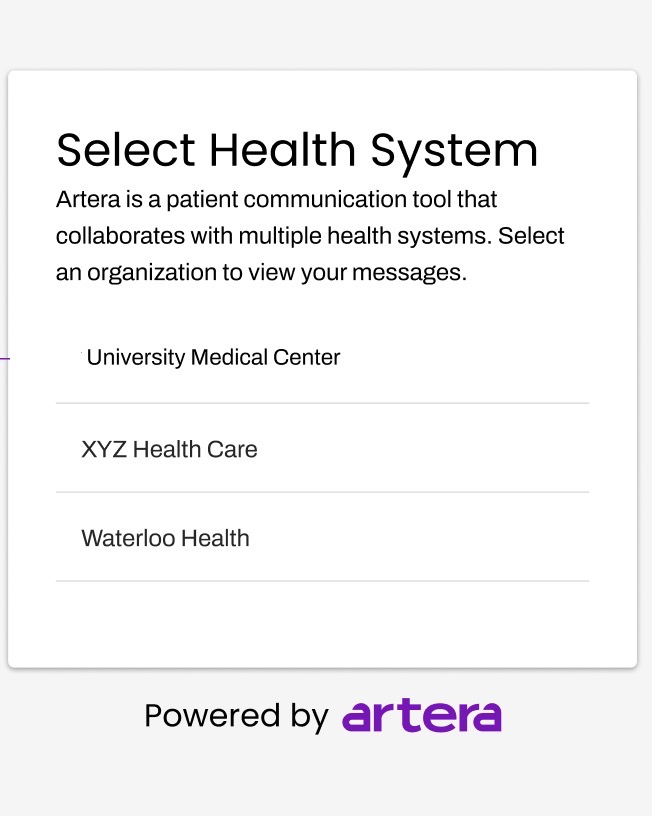
If the patient's phone number is on file at two or more organizations, they are asked to Select Health System. A patient with an account at only one organization does not see this step.
-
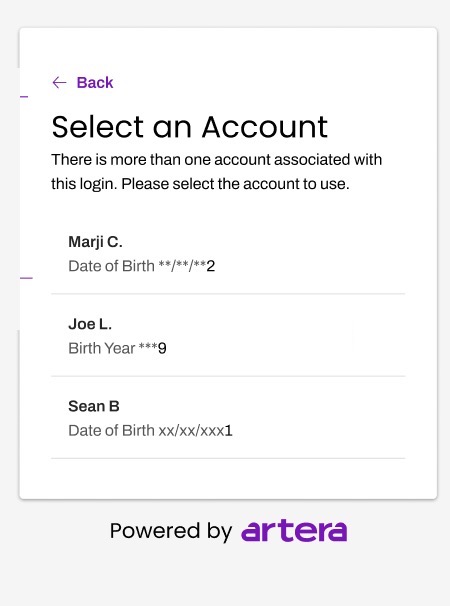
If two or more patient accounts at that organization share the phone number, the patient is asked to Select an Account and must choose their own. The first name, last initial, and partially redacted date of birth is displayed for each account. A patient whose number matches a single account does not see this step.
-
The patient is presented with a Verify Patient Identity window and must verify their identity with one of the options listed here. The identification verification varies depending on what is set up for the Patient Sign-In Security Criteria Default Setting. If Patient Sign-In Security Criteria is set to None, patients skip this step and are routed to the message.
NOTE: On this path, the verification screen does not name the patient and does not offer "Not Jane? Choose another patient." Those appear only when the patient arrives from a texted secure message link.
- Once their identity is successfully verified, the patient is routed to their Secure Messaging Portal.
Switching Patients
When a phone number is shared amongst patients, a Switch patient option appears for the patient next to the Logout button.  Selecting Switch patient routes the patient to the Select An Account page, where they must select the patient to view messages for and proceed to verifying the patient's identity.
